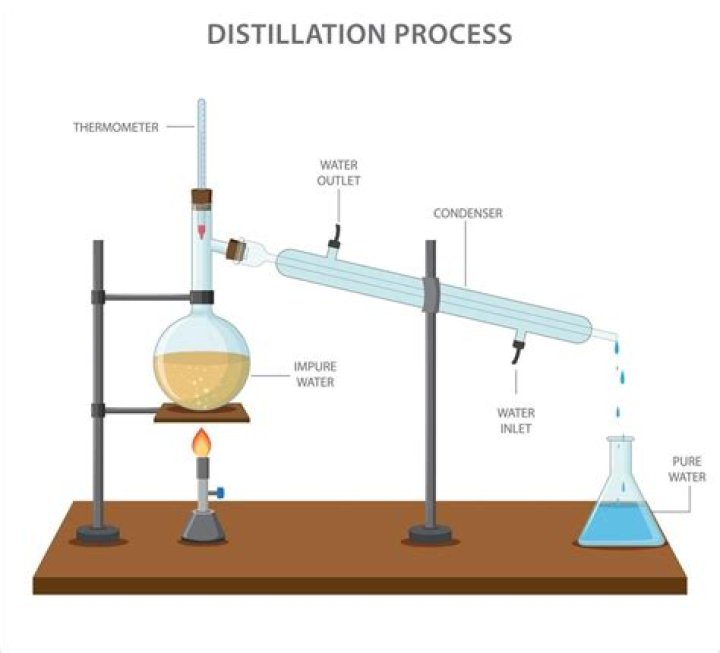
Why is it necessary to add boiling chips during the distillation of a liquid?
Boiling chips are frequently employed in distillation and heating. When a liquid becomes superheated, a speck of dust or a stirring rod can cause violent flash boiling. Boiling chips provide nucleation sites so the liquid boils smoothly without becoming superheated or bumping.
Why is it important to have a boiling chip present in the boiling flask when distilling liquid mixtures 2 What role does the steel wool serve in the fractional distillation setup used during the experiment?
It is important to have a boiling chip present when distilling liquid mixtures because it ensures the liquid heats and continues to boil evenly, as well as prevents it from boiling over. #1: What role does the steel wool serve in the fractional distillation setup used during the experiment?
What was the purpose of adding a boiling chip to your flask when making an ester?
A sharp boiling point is an indication of the purity of the ester. The procedure for the distillation of the mixture containing the ester is outlined below: To the mixture in the round bottom flask as prepared above, add boiling chips to prevent “bumping”.
Why should a distilling flask be filled not less than 1/3 filled or more than 2 3 full?
At the beginning of the distillation, the distillation pot should be between one-half full and two-thirds full. If the pot is too full, the surface area is too small for rapid evaporation and the distillation proceeds very slowly. If the pot is not full enough, there will be a large holdup volume and loss of sample.
What is the purpose of adding porcelain chips in distillation?
Hint: Porcelain chips are added before distillation in order to assure a nonviolent boiling. These chips help to heat up the solution faster and to create vapours than can rise quicker. This makes the distillation process much quicker, as compared to not adding chips present distillation.
What is the purpose of steel wool in fractional distillation?
The steel wool increases the surface area the vapors interact with and slows the movement of the vapors up the column. The longer the vapors take to reach the top of the column, the higher the purity of the fraction and the greater the efficiency of the column.
What are the consequences of forgetting to add a boiling chip to the distillation flask in this experiment explain your reasoning?
If boiling chips aren’t added to the flask, than the liquid would boil unevenly and can shake the flask, causing potential damage to the glassware.
Why can’t we get a 100% yield during esterification?
The reaction is reversible and the reaction proceeds very slowly towards an equilibrium. It is difficult to achieve 100% conversion and the yield of the ester will not be high. This equilibrium can be displaced in favour of the ester by the use of excess of one of the reactants.
Why is a flask never distilled to dryness?
NEVER distill the distillation flask to dryness as there is a risk of explosion and fire. The most common methods of distillation are simple distillation and fractional distillation. Simple distillation can be used when the liquids to be separated have boiling points that are quite different.
What happens if the flask is filled very rapidly during distillation?
Distilling at too fast a rate prevents proper equilibration between liquid and gas phases, and results in poor separation. Although a slow distillation is necessary, heating the solution such that nothing is dripping into the receiving flask simply wastes time.
What does a boiling stick do?
“Boiling sticks” (wood splints) are also used to encourage smooth boiling. They are plunged directly into a solvent or solution, and act much the same as boiling stones: they too are highly porous and contain nucleation sites. The main advantage of boiling sticks is that they can be easily removed from a solution.
Why do you put boiling chips in the distillation flask?
Boiling chips should be placed in the distillation flask for two reasons: they will prevent superheating of the liquid being distilled and they will cause a more controlled boil, eliminating the possibility that the liquid in the distillation flask will bump into the condenser. Also Know, what happens if you add boiling stones to a heated liquid?
When to use a boiling chip in a solvent?
Always use a boiling chip when heating a solvent. Never add a boiling chip to a solvent which is already hot, because it can cause to solvent to boil over violently. If you forget to add a boiling chip before you begin, you must cool the solution before adding one to prevent product loss.
What happens if you forget to add boiling chips?
If you forget to add a boiling chip before you begin, you must cool the solution before adding one to prevent product loss. Boiling chips cannot be re-used since the pores inside these stones become filled with liquid on cooling. Back to Distillation Original content © University of Colorado at Boulder, Department of Chemistry and Biochemistry.
Why are boiling stones used in distillation and heating?
Boiling chips are frequently employed in distillation and heating. When a liquid becomes superheated, a particle of dust or a stirring rod can cause violent flash boiling. Boiling chips provide nucleation sites so the liquid boils smoothly without becoming superheated or bumping.
Why do you use boiling chips in distillation?
boiling chips are added to both simple and fractional distillation flask because they create a more even and controlled boil. In addition, they create prevent superheating of the liquid being distilled. the alkenes were broken by the liquid bromine since the mixture turned clear, this means that the compounds reacted.
Boiling chips are frequently employed in distillation and heating. When a liquid becomes superheated, a particle of dust or a stirring rod can cause violent flash boiling. Boiling chips provide nucleation sites so the liquid boils smoothly without becoming superheated or bumping.
If you forget to add a boiling chip before you begin, you must cool the solution before adding one to prevent product loss. Boiling chips cannot be re-used since the pores inside these stones become filled with liquid on cooling. Back to Distillation Original content © University of Colorado at Boulder, Department of Chemistry and Biochemistry.
Why are there bubbles in a boiling chip?
These stones have pores inside which provide cavities both to trap air and to provide spaces where bubbles of solvent vapor can form. These bubbles ensure even boiling and prevent bumping and boiling over and loss of the solution.
